
Vehicle intelligence is typically divided into five major domains: powertrain, chassis control, body control, smart cockpit and autonomous driving.
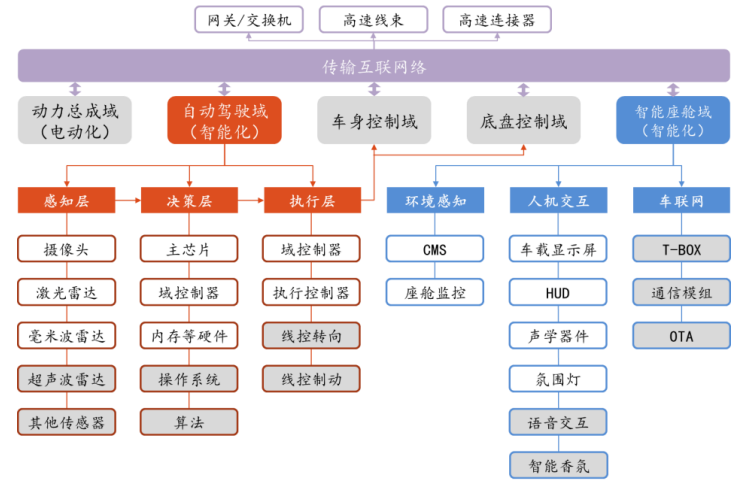
(Figure: Domain Partitioning for Automotive Intelligence)
Source: Eastmoney Securities
Beyond autonomous driving, the smart cockpit represents one of the core pillars of vehicle‑wide intelligence. It comprises three modules: environmental perception, human‑machine interaction (HMI), and vehicle‑to‑everything connectivity.
Environmental Perception: Camera Monitor System
(CMS), cabin monitoring, and air‑quality sensors.
Human‑Machine Interaction: On‑board displays, Head‑Up Display (HUD), audio systems, ambient lighting, smart fragrance diffusers, and voice interaction.
Vehicle‑Network Connectivity: Bluetooth, Wi‑Fi, NFC, UWB, OTA updates, and T‑BOX telematics units.
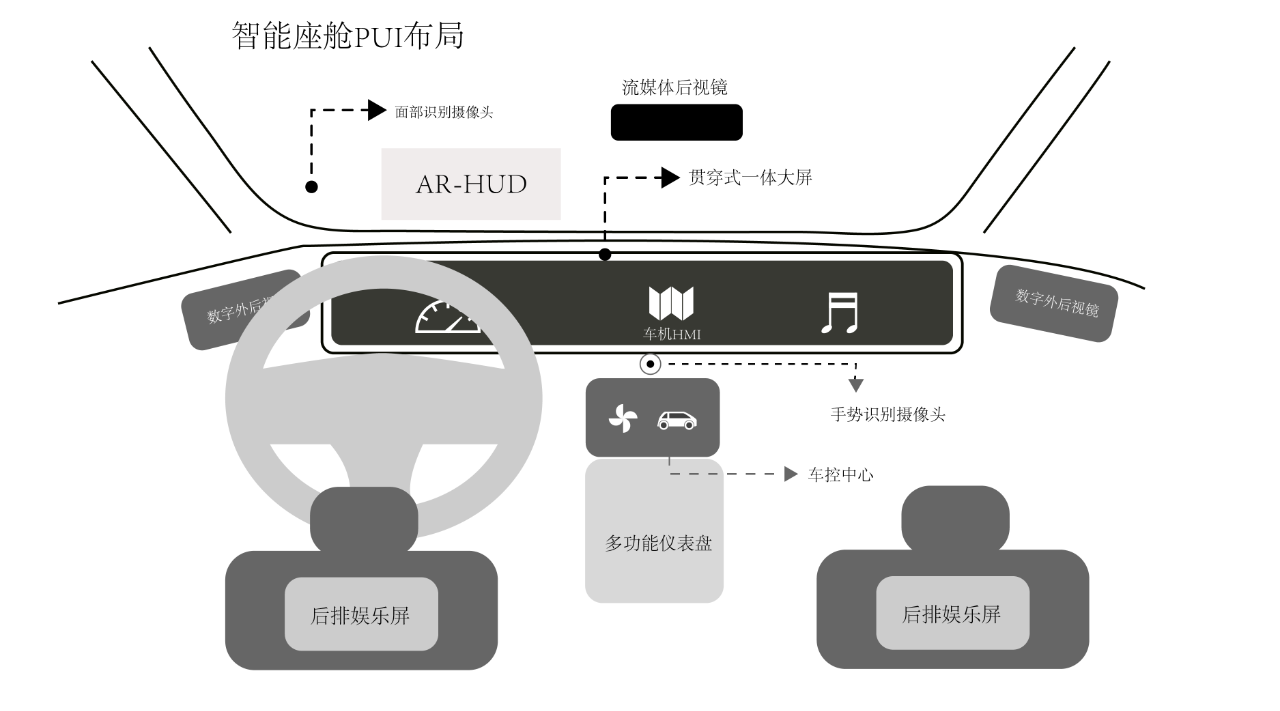
(Figure: Smart Cockpit PUI Layout)
Built upon interaction safety, smart cockpits keep evolving across multiple technical dimensions: in‑vehicle connectivity, voice interaction, driver‑status monitoring, biometric recognition, vehicle‑road coordination, safety early‑warning, IoT integration and cybersecurity. Meanwhile, user experience is continuously enhanced in comfort, intelligence and in‑car office scenarios.
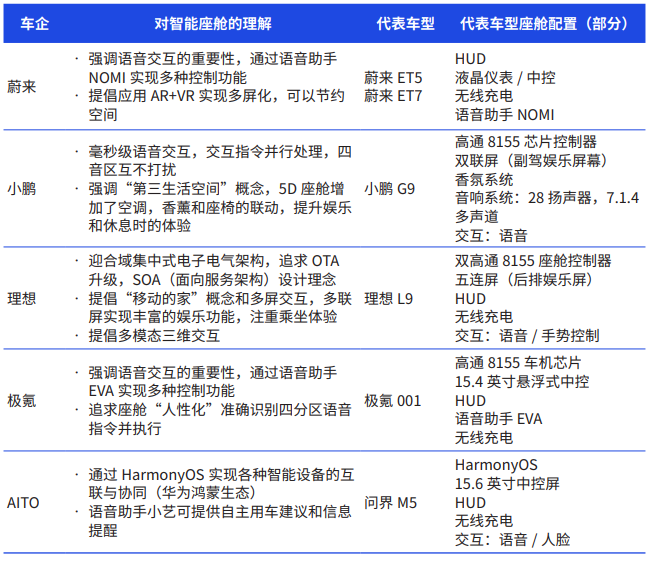
(Table: OEM Value Propositions and Configurations for Smart Cockpits)
According to KPMG projections, China’s smart‑cockpit market will reach CNY 212.7 billion by 2026, with a 5‑year compound annual growth rate (CAGR) exceeding 17%. HUD and domain controllers will serve as key growth drivers.
Per‑vehicle value is expected to rise from CNY 8,100 in 2022 to CNY 9,650 in 2026. Over the same period, smart‑cockpit penetration will increase from 59% to 82%.
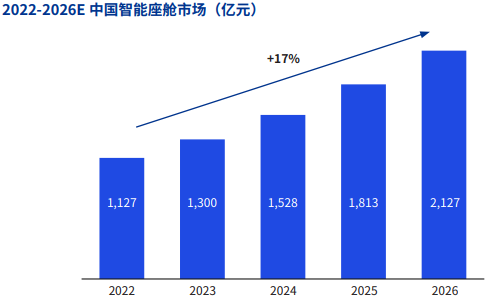
(Bar Chart: China Smart‑Cockpit Market 2022‑2026E)
Source: KPMG
Major changes in smart‑cockpit hardware fall into two categories:
Component Upgrades: Central control screens, instrument clusters, rear‑view mirrors, chips, ambient lighting, audio systems, seating systems, etc.
Newly‑Added Components: Cockpit domain controllers, intelligent voice modules, HUD, digital keys and more.
The cockpit domain controller and its System‑on‑Chip (SoC) constitute the computation and decision‑making hub of the vehicle. The domain controller processes cockpit‑sourced commands, while the SoC executes computation and control for in‑cabin devices.
Driven by advances in automotive Electrical‑Electronic Architecture (EEA), the cockpit‑domain‑controller market is forecast to achieve an 82% CAGR between 2022‑2026. Current per‑unit vehicle value stands at roughly CNY 1,500, and unit pricing will rise as more functions are integrated within the domain.
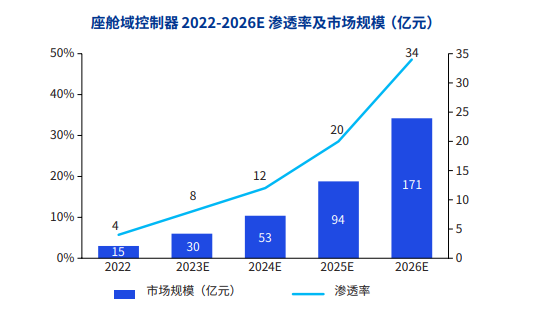
(Chart: Cockpit Domain Controller Penetration & Market Size 2022‑2026E)
Source: KPMG
Cockpit SoCs integrate CPU, GPU, Neural‑Processing Unit (NPU) and other computing cores. They define data throughput, processing speed and graphics‑rendering performance of the domain controller, and directly determine end‑user smart‑cockpit experience. The domestic cockpit‑SoC market is expected to record a 32% CAGR over the next five years.
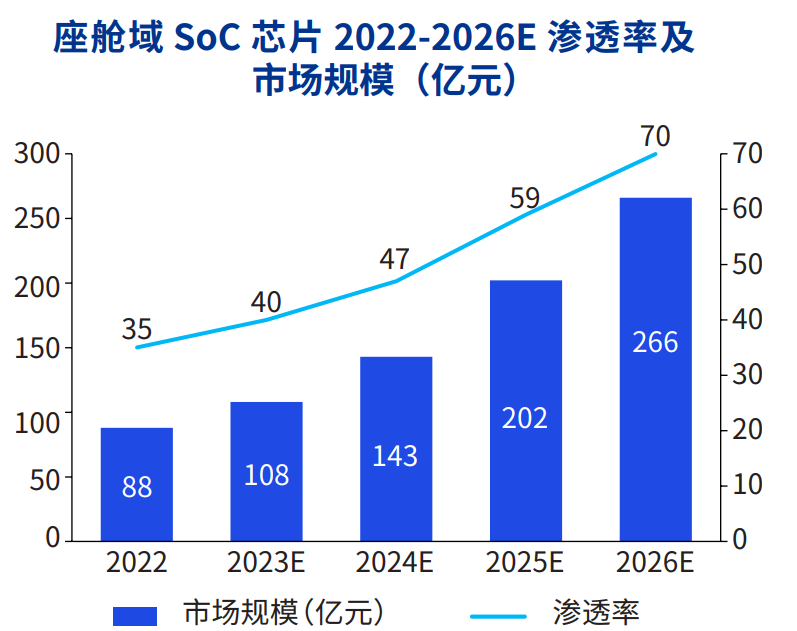
(Chart: Cockpit‑Domain SoC Penetration & Market Size 2022‑2026E)
Source: KPMG
A Head‑Up Display (HUD) projects vehicle speed, fuel consumption, tire‑pressure readings, infotainment and other data onto the windshield. In‑vehicle HUD reduces the frequency of driver gaze diversion toward instrument panels and improves driving safety.
Three mainstream projection technologies are deployed for automotive HUD: TFT (Thin‑Film Transistor), DLP (Digital‑Light‑Processing), and LCoS (Liquid‑Crystal‑on‑Silicon).
TFT Solution: Most mature, low‑cost and mass‑production‑friendly; limited field‑of‑view, moderate resolution and notable thermal‑dissipation challenges.
DLP Solution: Proven technology delivering better imaging performance than TFT; higher bill‑of‑materials cost, with ghosting and distortion artifacts.
LCoS Solution: Superior brightness, contrast and resolution; lower technical maturity and higher cost.
Based on display form factor, HUD products are classified as C‑HUD, W‑HUD and AR‑HUD.
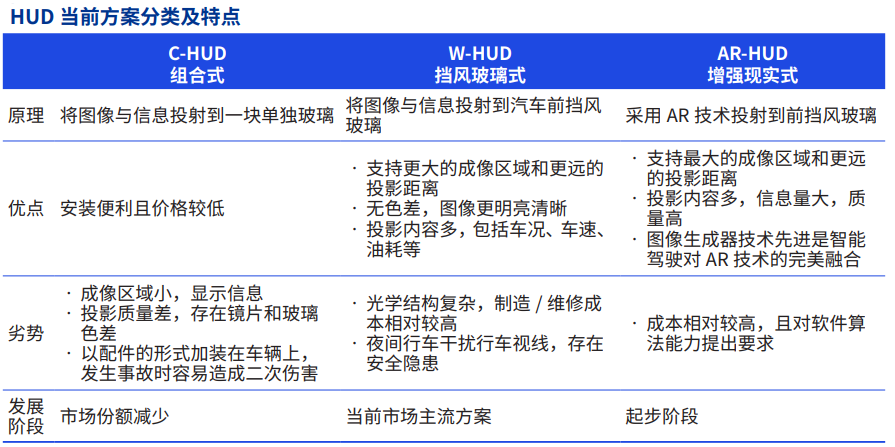
(Table: Classification and Characteristics of Current HUD Solutions)
Source: KPMG
As HUD technology matures and more HUD‑equipped vehicles go into mass production, HUD fitment rate for passenger vehicles is projected to reach approximately 55% by 2026 — 30% for W‑HUD and 25% for AR‑HUD. The segment will deliver a 53% CAGR for 2022‑2026.
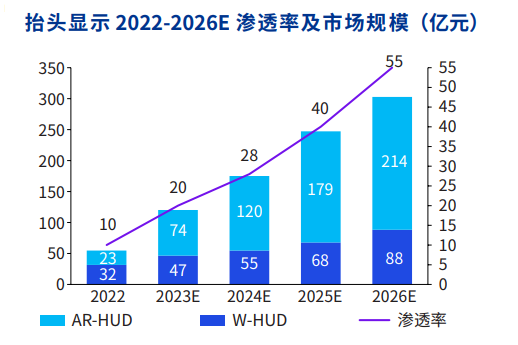
(Chart: HUD Penetration & Market Size 2022‑2026E)
Source: KPMG
The central‑control display is the largest in‑cabin screen and serves as the primary human‑machine interface for infotainment systems. It already enjoys high market penetration. Market trends point toward larger panel sizes, higher resolution, multi‑modal interaction and multi‑screen architectures.
Larger‑screen Trend: Large central displays have become mainstream. Extra‑wide panels extending to passenger‑side screens are gaining traction, expanding service coverage from drivers to front‑passenger occupants.
High‑definition Trend: Conventional LCD remains the most widely‑adopted automotive display with proven maturity, yet constrained by inherent optical drawbacks. OLED and Mini‑LED are rapidly adopted for superior image quality. Micro‑LED is still technically immature with high manufacturing costs and awaits large‑scale commercial rollout; volume shipments are anticipated post‑2025.
Multi‑modal Interaction: Gesture, touch, voice and eye‑tracking inputs partially replace mechanical physical buttons.
Multi‑screen Trend: Single‑SoC multi‑screen architectures bring prominent advantages, enabling free data flow and cross‑screen interaction across multiple displays.
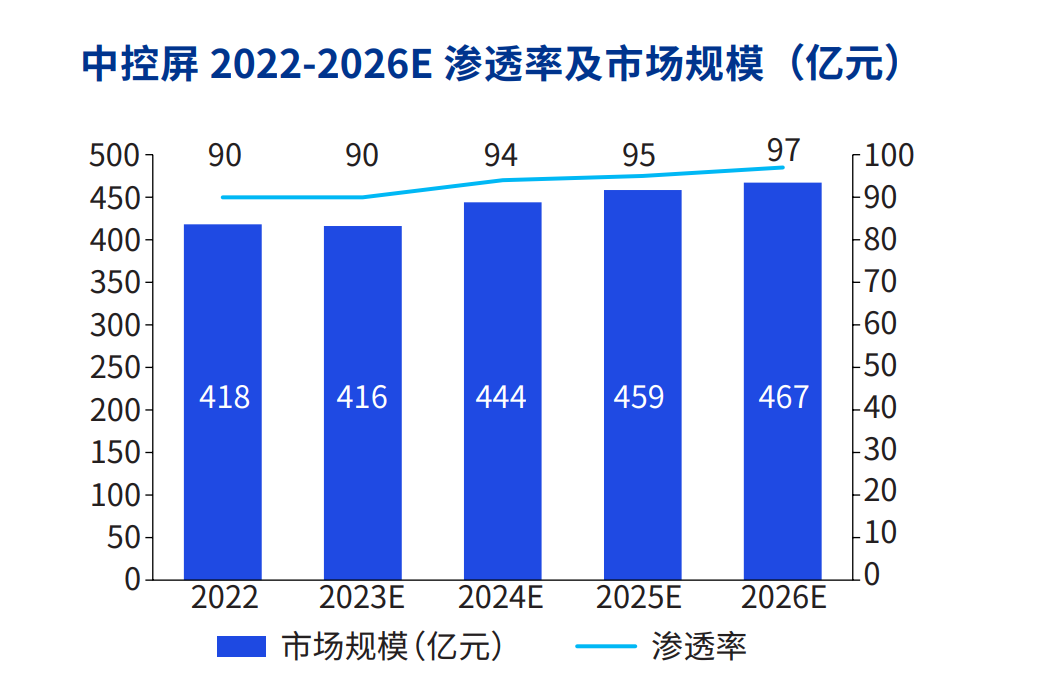
(Chart: Central‑Control‑Display Penetration & Market Size 2022‑2026E)
Source: KPMG
Domestic central‑control‑display penetration exceeds 90%, ranking highest among smart‑cockpit components. Its 2022‑2026E CAGR stands at 3%.
Streaming media rear‑view mirrors replace physical mirror glass with built‑in screens. External cameras capture real‑time road scenery instead of direct human optical reflection, supporting dual‑mode operation (streaming‑media mode and conventional mirror mode) to mitigate weaknesses of traditional rear‑view mirrors.
The OEM‑fit streaming‑media‑mirror market remains in early‑stage deployment with low penetration. Further adoption will occur alongside advanced ADAS functions, with projected 55% CAGR for 2022‑2026E.
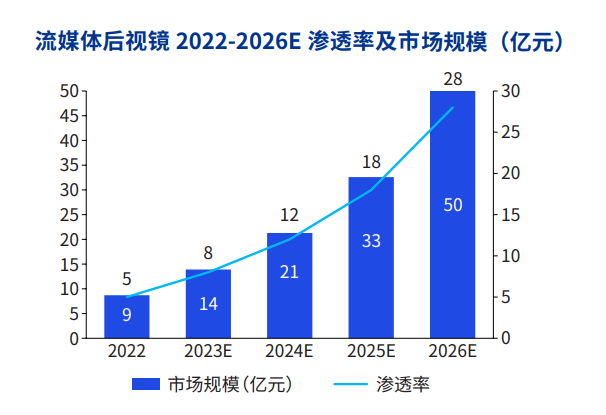
(Chart: Streaming‑Media Rear‑view Mirror Penetration & Market Size 2022‑2026E)
Source: KPMG
Digital‑key technology leverages NFC (Near‑Field Communication), BLE (Bluetooth Low‑Energy), UWB (Ultra‑Wideband) and other wireless standards to turn consumer smart devices into vehicle keys. Supported features include passive entry‑and‑start, remote access authorization for third parties, and personalized vehicle‑profile configuration. As an innovation enabled by smart‑cockpit evolution, digital keys offer portability, seamless user experience and secure key‑sharing capabilities.
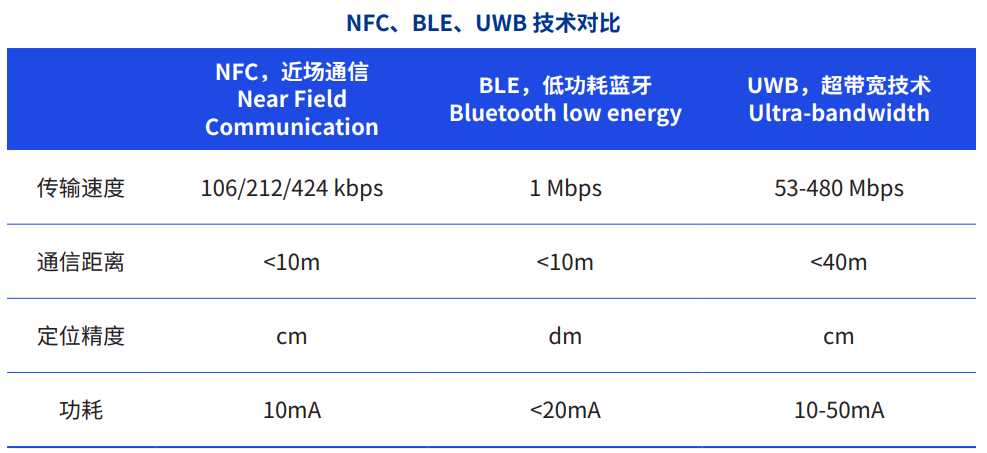
(Table: Technology Comparison among NFC, BLE and UWB)
Source: KPMG
Hybrid schemes combining NFC, BLE and UWB are expected to dominate the future market, coping with variable operating conditions such as changing communication distances or network outages. Typical workflow: BLE wakes up the UWB chip for encrypted data transmission; UWB undertakes high‑precision positioning; NFC serves as fallback access when the mobile device runs out of power. This combination closes the full smart‑cockpit user‑experience loop.
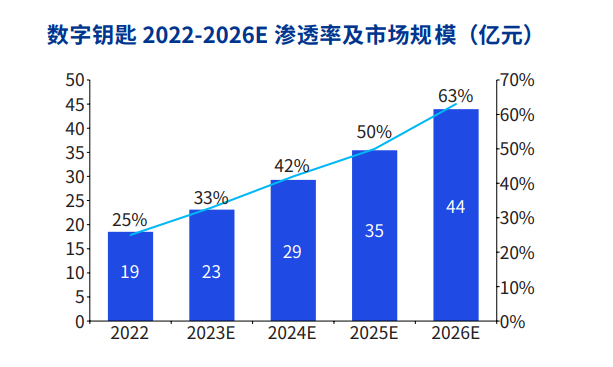
(Chart: Digital‑Key Penetration & Market Size 2022‑2026E)
Source: KPMG
PCB value content for ordinary passenger vehicles averages around CNY 400 per unit.
Electrification‑driven PCB incremental value mainly comes from:
Approximately CNY 2,000 increment for electric‑control systems;
Roughly CNY 600 added value from FPC replacing conventional wire harnesses within battery packs.
Electrification‑related PCB value per vehicle is projected to rise at an annual rate of 3%.
Intelligence‑driven PCB growth originates from autonomous‑driving and smart‑cockpit electronics, bringing roughly CNY 400 incremental PCB value per car. Annual value uplift from intelligence‑related PCB is expected to hit 5% as electronic systems iterate.
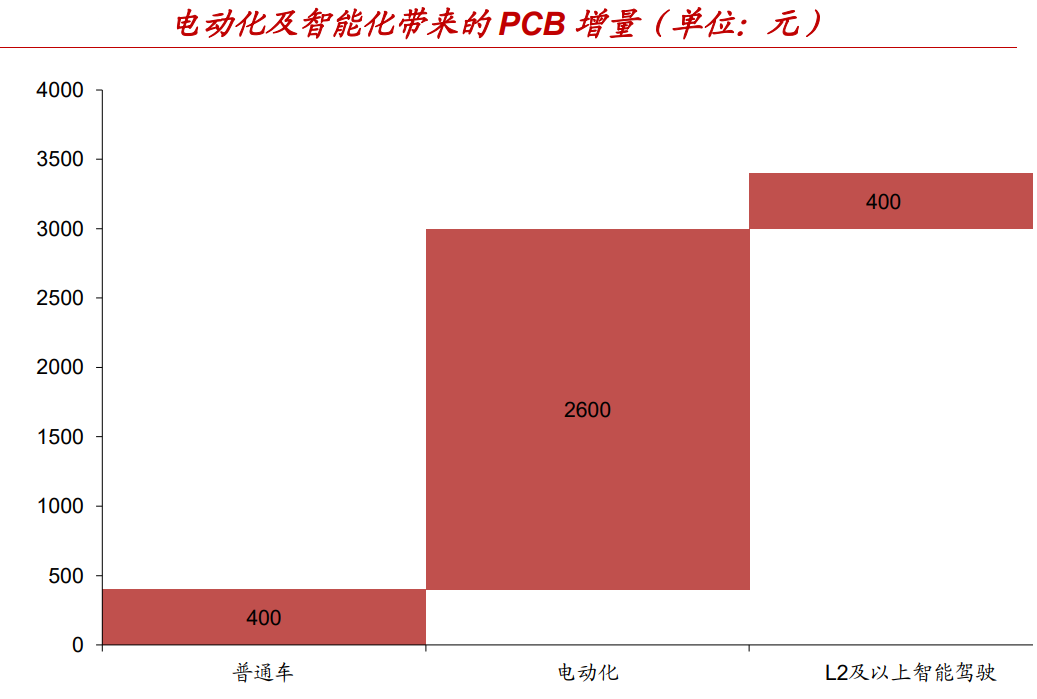
(Diagram: PCB Value Increment Brought by Electrification & Intelligence, Unit: CNY)
Source: Zhongtai Securities
Looking ahead, fueled by vehicle electrification and intelligence, China’s automotive‑PCB market size is projected to reach CNY 123.3 billion by 2025, representing a 24% CAGR over 2020‑2025.
Taking 2022 statistics as reference: multi‑layer PCBs remain mainstream for automotive applications, yet their market share has declined from 51% (2018) down to 45% (2020). Combined market share of high‑end HDI boards, RF boards and flexible/rigid‑flex PCBs rose from 24.3% (2018) to 33.5% (2020).
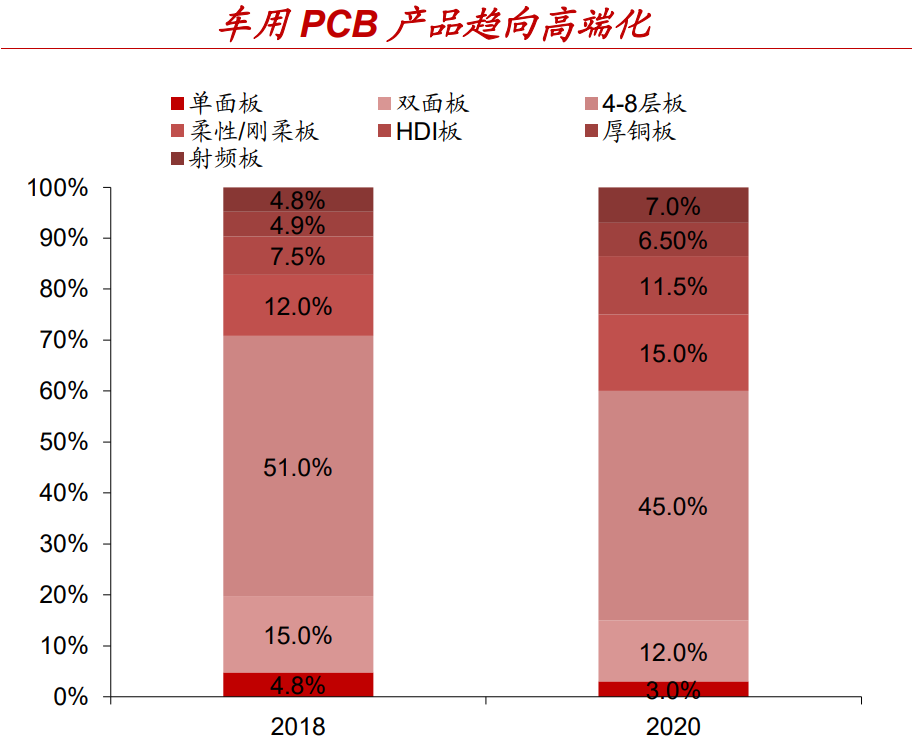
(Stacked Bar Chart: Automotive PCB Product Migration toward High‑end Specifications)
Source: Zhongtai Securities
New‑energy vehicles deploy large volumes of high‑frequency PCBs for millimeter‑wave radar modules. Battery packs, camera assemblies extensively adopt FPC and rigid‑flex circuits. LiDAR, smart‑cockpit units, ECUs and ADAS systems require fine‑feature HDI PCBs due to dense circuit routing. As NEV penetration keeps climbing, high‑end automotive‑PCB product mix will continue expanding.
Reference Sources:
White Paper: The Second Phase of Electrification — Focus on Smart Cockpit, KPMG
Underlying Technical Platform for Smart‑Cockpit Domains, Eastmoney Securities
Vehicle Electrification & Intelligence Fuel New Growth for PCB Industry, Zhongtai Securities
 WeChat